What NSW Waterproofing Rules Mean for Your Walk-In Shower Cost in Sydney (2026)
If you've been pricing a walk-in shower cost in Sydney and the quotes don't quite add up, there's usually a simple reason: the screen is the easy part, and the waterproofing underneath it is where the real money and the real risk sit. Most homeowners budget for glass and tiles and forget that a walk-in shower only works if the membrane, the fall of the floor and the drainage are done to code. Get that wrong in a terrace in Marrickville or a 1970s brick-veneer in Castle Hill and you're not looking at a cosmetic fix later, you're looking at ripping out new tiles to chase a leak into the subfloor.
This isn't a scare campaign. Walk-in showers are genuinely one of the best upgrades you can make to a Sydney bathroom renovation, especially if you're trying to future-proof the house or just want something that looks less like a shower stall and more like a hotel bathroom. But the cost and the compliance are tied together more tightly than most renovation blogs let on, so it's worth understanding both before you sign anything.
What's Actually Driving the Price
Strip away the marketing and a walk-in shower is three separate line items: the screen, the waterproofing, and the floor prep that lets water run where it's supposed to. (Explore our detailed breakdown on bathroom renovation costs across Sydney trades for complete line-item context).
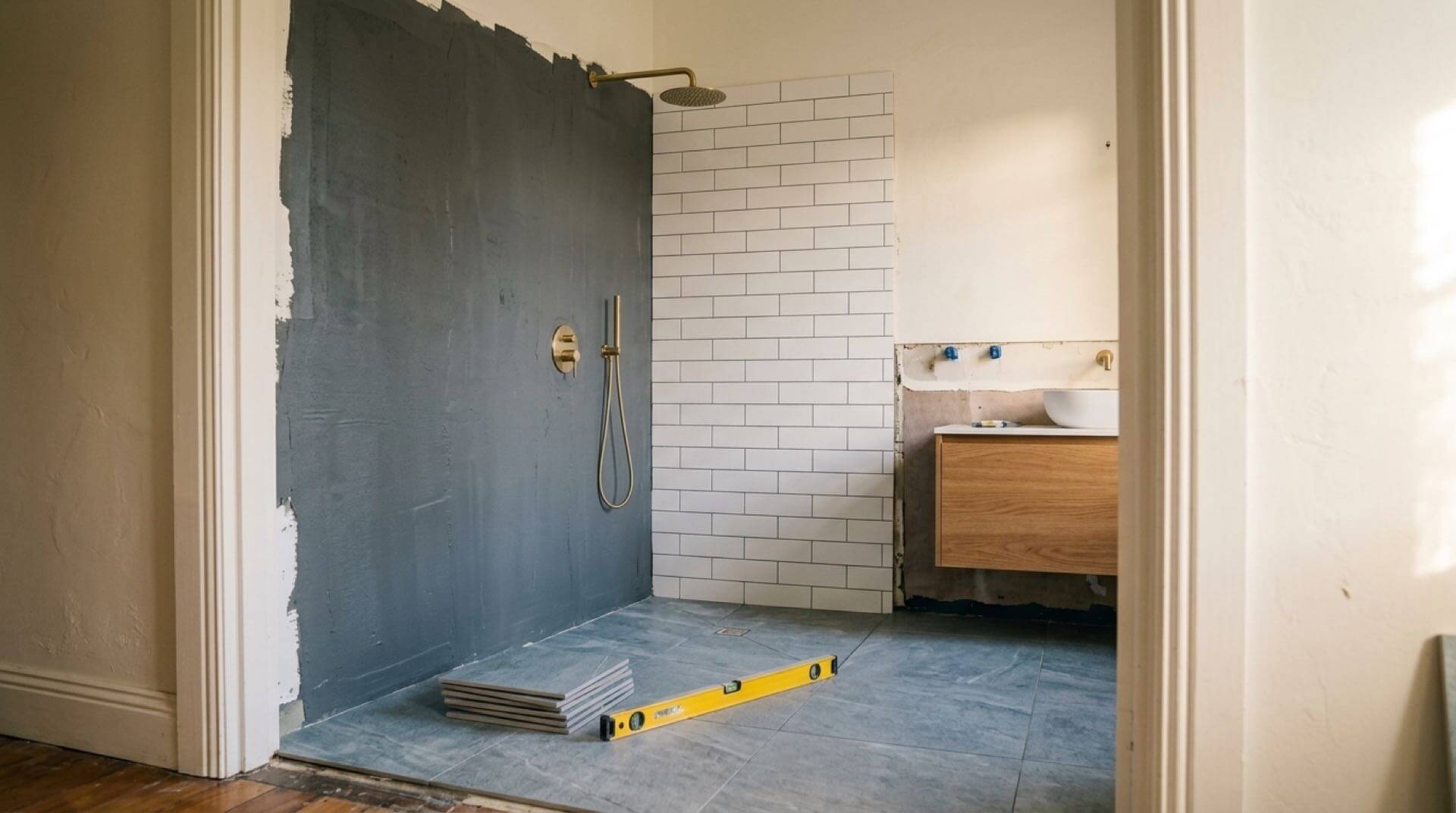
On screens, you've got real choice, and the price gap between options is bigger than most people expect. A framed fixed panel still comes in around $500 to $800 installed, and a framed pivot door sits roughly $650 to $1,000. Step up to semi-frameless hinged screens and you're in the $700 to $1,200 range. Go fully frameless and a hinged panel runs $900 to $1,700, while a frameless sliding two-panel setup can hit $1,800 to $3,500 or more depending on glass size and hardware. A frameless walk-in fixed panel, which is the look most people actually picture when they say "walk-in shower," typically lands between $700 and $1,300.
The glass itself isn't interchangeable either. Frameless screens use 10 to 12mm toughened glass because there's no metal frame doing the structural work, while semi-frameless gets away with 8mm since the aluminium edging takes some of the load. Both have to meet AS/NZS 2208 for safety glass and AS 1288 for installation, no matter which style you pick. The frameless look is undeniably cleaner, and it makes a small bathroom feel bigger because there's nothing chopping up your sightline—a smart design move often deployed in our small ensuite renovations—but it costs more and it's less forgiving if your walls aren't perfectly square, which plenty of older Sydney homes aren't.
The Waterproofing Rules Most Quotes Don't Mention
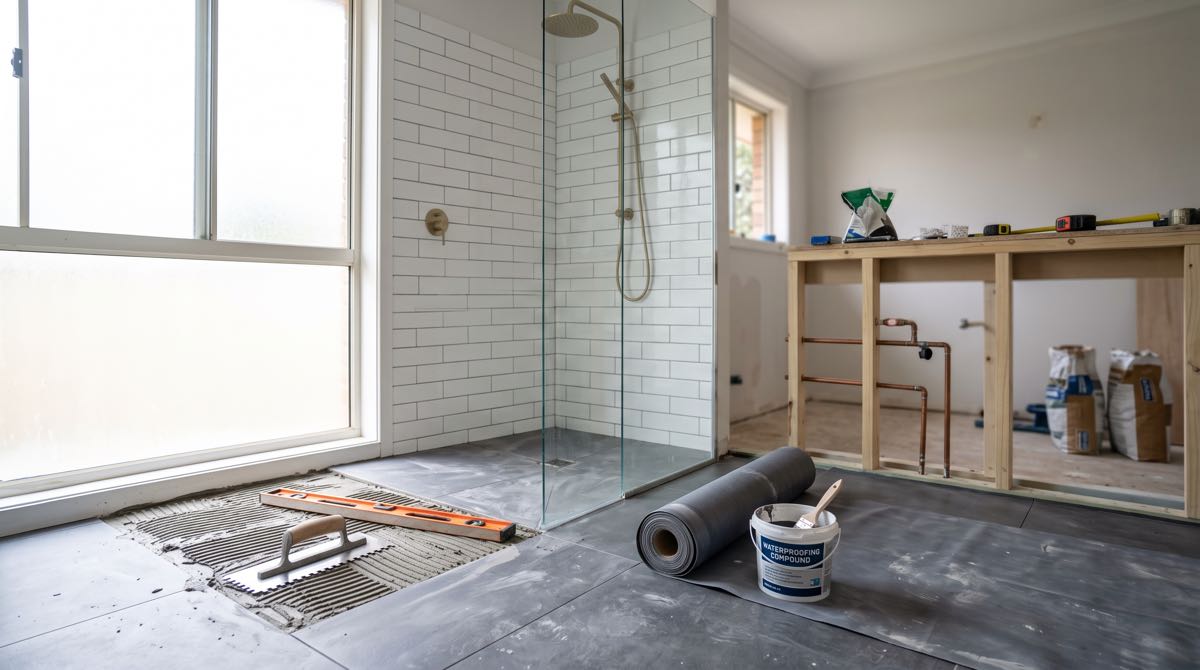
Here's the part that catches people out. Under NSW regulation, any waterproofing job worth more than $500 has to be done by a licensed contractor holding a current NSW Fair Trading licence, and a proper walk-in shower almost always clears that threshold once you include the floor, the walls and the drain penetrations. If your builder is quoting a walk-in shower without mentioning who's doing the waterproofing and whether they'll hand you a signed certificate at the end, ask. That certificate needs to name the contractor, their licence number, the membrane system used, the installation date, and a statement that the work meets AS 3740:2021 and AS 4858:2020. Without it, an insurer can knock back a water damage claim outright, and it can also flag as a problem if you ever sell. (Read more in our guide on council approvals and AS 3740 standards in Sydney).
The 1800mm Rule Nobody Tells You About
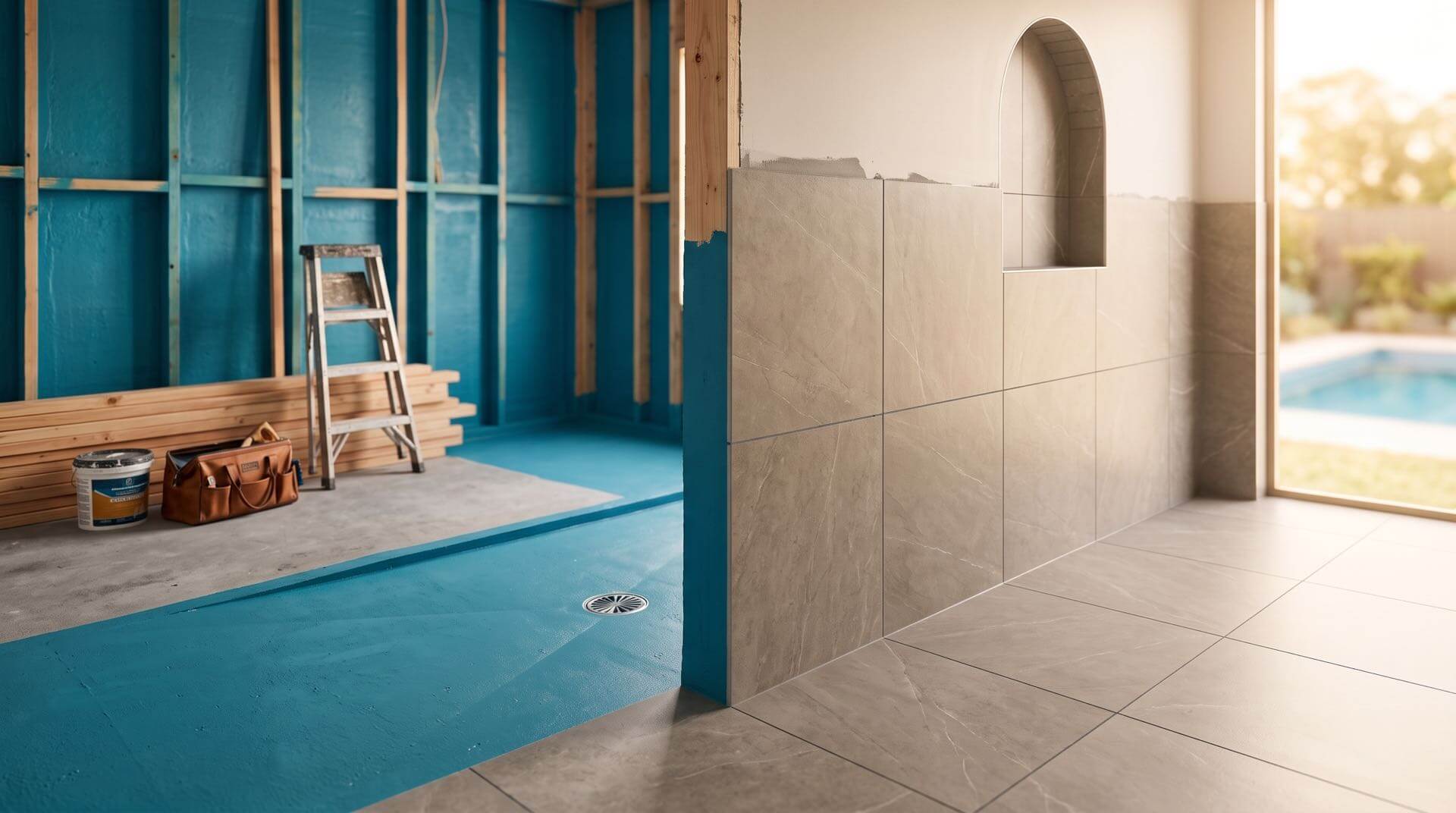
The standard sets a minimum waterproofing height of 1800mm up the shower walls, and the membrane has to turn up at least 150mm above the finished floor around the rest of the bathroom, not just inside the shower recess. For a walk-in shower with no hob or screen running floor to ceiling, this matters even more, because there's less physical barrier stopping splash from reaching the rest of the room. A good waterproofer will take the membrane behind the tile backer board and over every pipe penetration and drain fitting too, since that's where most failures actually start. It's unglamorous work, and it's completely invisible once the tiles go down, which is exactly why it's the step some renovators try to rush. See how our bespoke team tackles detail in custom bathroom designs.
Getting the Fall and Drainage Right
A true walk-in shower, the kind with no step and no raised hob, lives or dies on fall. The floor has to pitch toward the drain at the correct gradient across the whole wet area, not just directly under the showerhead, or you end up with water pooling at the edges where the tiler ran out of patience. Linear or channel drains have become the go-to choice for walk-in designs in Sydney renovations because they let the floor fall in one direction only, which is both easier to execute well and easier to inspect. A point drain in the middle of an open shower area means the floor has to fall evenly from every direction, and that's a much harder thing for a tiler to get right, especially on a reno with an irregular room shape.
If your bathroom sits on a timber or particleboard subfloor, which is common in older Sydney houses, that substrate needs its own waterproofing treatment before the membrane goes over it. Skipping this step is one of the most common compliance failures inspectors flag, right up there with gaps at wall junctions and pipe penetrations that never got properly sealed. You can explore high-end examples of seamless level wet rooms in our luxury bathroom renovations and inspect real-world finishes in our renovation gallery.
What to Ask Before You Sign
Before you commit to a quote, ask three things: who holds the waterproofing licence and can they show it, what membrane system they're using and does it meet AS 3740 and AS 4858, and will you receive a signed waterproofing certificate at completion. A renovator who answers all three without hesitation is one who's done this properly before. One who gets vague about the waterproofing but has a beautiful screen catalogue ready to show you is one to be cautious of. Learn more about our licensed team and guarantee.
None of this should put you off a walk-in shower. Done properly, it's one of the renovations that actually adds value to a Sydney home, not just comfort. The trick is spending your attention on the part you can't see rather than only the part you can. Ready to plan your renovation with fully compliant waterproofing? Contact our team for a free consultation.
Ready to get a real number for your bathroom?
Get a free, no-obligation quote based on your actual layout — not a rough estimate.